Compare · Idea validation
Idea validation tools compared
An enthusiastic answer to “Would you use this?” tells a founder very little. Idea validation tools are more useful when each one tests a separate doubt: do people have the problem, understand the offer or take a step towards paying? An idea validation service can help frame those questions. PennyForYours offers a first-reaction check with UK adults, not proof of demand. Last checked: 7 October 2026.
We review requests by hand.

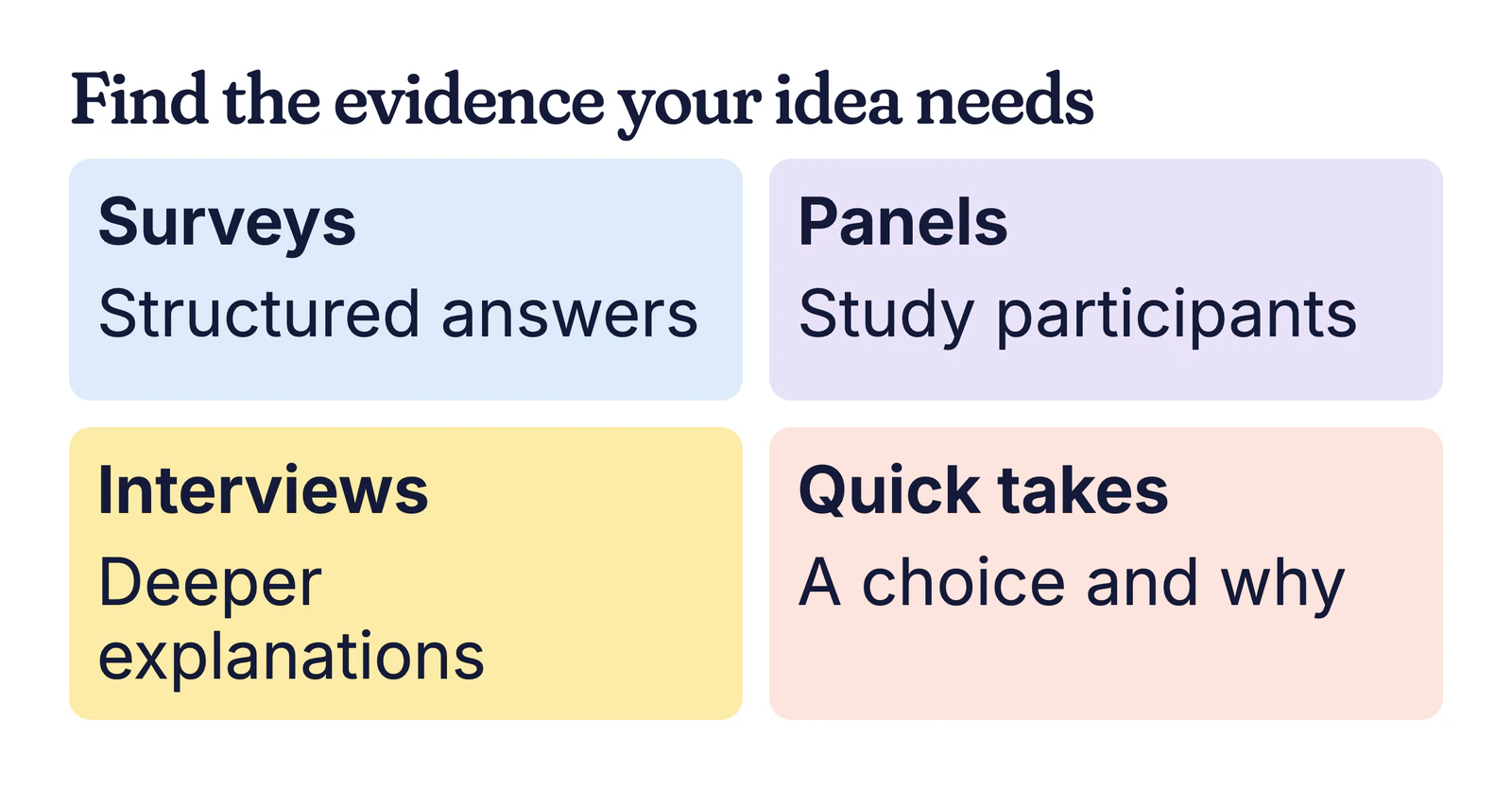
Idea validation tools by evidence type
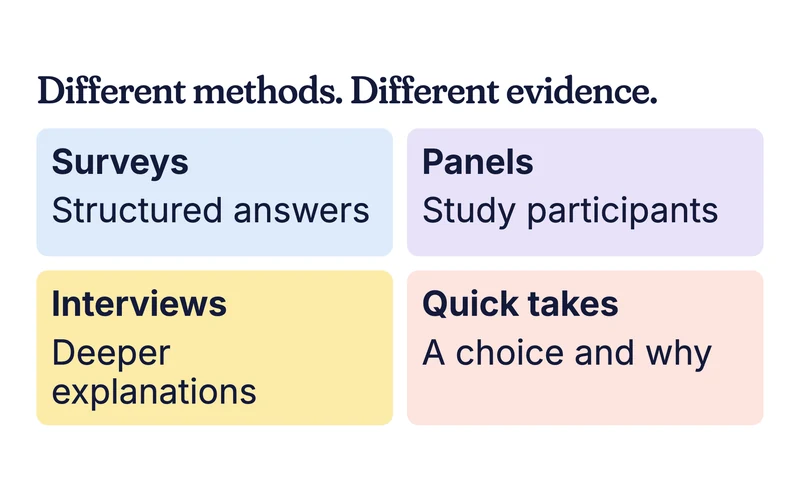
Each option answers a different part of the idea. Pick the next uncertainty you can afford to test.
| Job | Tool or method | What the signal means |
|---|---|---|
| Ask a selected group | PickFu and Prolific | Compare options or recruit eligible study participants. A stated preference is not a purchase. |
| Watch product use | Lyssna, UserTesting and Maze | Test a prototype or task. Watch where people struggle, then change the design. |
| Look for interest | Google Trends | Explore relative search interest, not buyer counts, as Google explains. |
| Test a real step | A landing-page smoke test with a small ad spend | Measure clicks or sign-ups before building more; set a spend limit first. |
| Hear objections | Reddit and relevant online communities | Read existing discussions and ask openly where the rules allow. Members self-select. |
| Draft hypotheses | AI idea validators | Useful for questions to investigate; generated judgements are not customer evidence. |
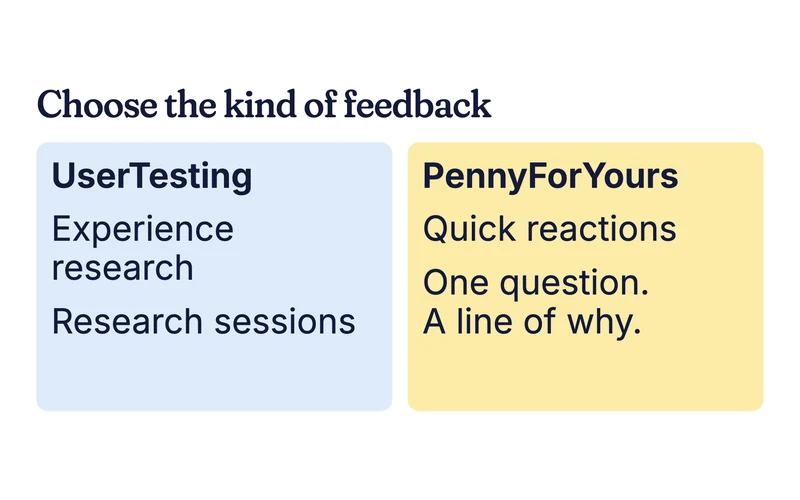
| Check a first reaction | PennyForYours | Ask 5 to 50 general UK adults one short question, without buyer targeting. |
Run the cheapest relevant check first. A polite survey answer, a search trend and a paid sign-up measure different things; keep those signals separate when you decide what to build.
When an idea validation service helps
Use interviews before you settle the problem
Ask people what they do now and what happened the last time the problem arose. Avoid pitching your proposed answer and asking whether they like it. A polite ‘yes’ costs a respondent nothing. Their current workaround, time spent or money already paid gives you firmer evidence.
Use a survey or panel when you need a defined group
PickFu publishes poll formats and audience selection [1]; Prolific describes participant selection for studies [2]. Those are better choices when an answer from a specific buyer group matters. A founder selling to UK dentists, for example, should not treat opinions from 20 general adults as a proxy for dentists. Check how the platform identifies your audience before paying for the study.
Use PennyForYours to spot a confusing choice
If your next decision is between two names, show both without signalling your favourite and ask which better describes the service. Read the reasons, not only the split. Ten people may misunderstand a word for the same reason; that is worth fixing even if the winning option has more votes. A name test is an early check, followed by domain, trade mark and customer checks where relevant.
Official product pages checked 7 October 2026: [1] PickFu survey formats; [2] Prolific research workflow; [3] Lyssna research methods. The comparison table also links to official pages for UserTesting, Maze and Google Trends data. Method limits are editorial guidance, not vendor promises.
Use quick takes to test a specific choice
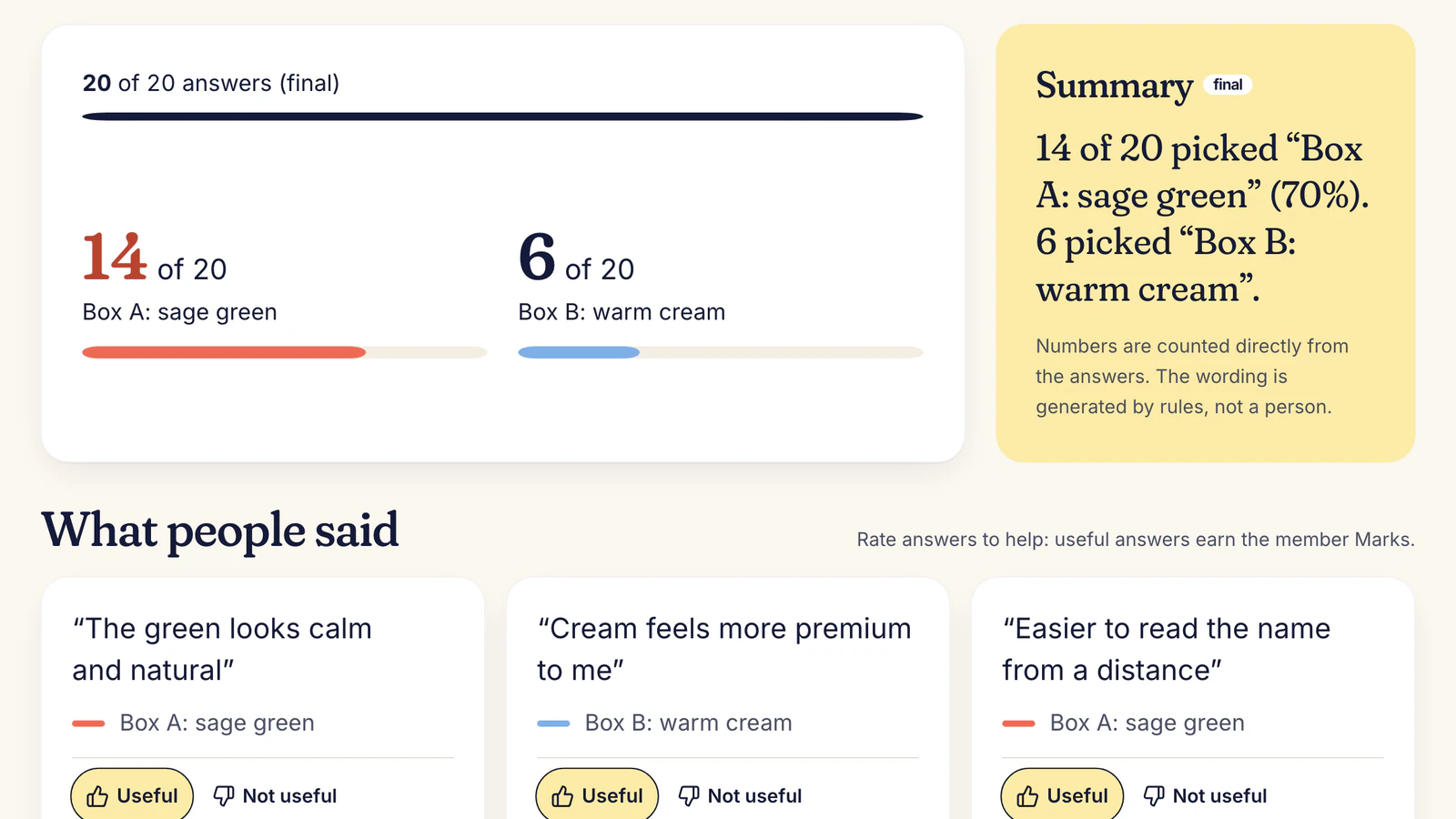
A quick take works best when the uncertainty is narrow. Show up to 280 characters of text or one uploaded image, perhaps two name options placed side by side. Ask 5 to 50 UK adults to pick between two or three options, rate from 1 to 5, or give a first impression. Each person adds a short reason; none is being asked to predict whether a business will succeed.
Results show the split or average, all the reasons, a short summary with up to three unnamed quotations and a signed receipt for each answer. The receipt records checks passed, not proof of market demand. No demographic targeting is available yet. Read our verification approach and its limits before using a result to guide a costly choice.
At paid launch, a quick take starts from 30p an answer plus 50p a question (launch example); asking is free during early access. We aim for first answers within about 15 minutes in UK daytime, though early access can be slower. Use the result to improve a question or narrow a shortlist, then look for behaviour that tests demand.
Start with the riskiest assumption
Write one sentence that could prove you wrong. “People will pay” points towards a pre-order or a sales conversation. “People cannot tell what we sell” points towards a wording test. The asking guide shows the current quick-take formats; price-sensitivity methods answer a different question.
Request early access if a small first-reaction check would settle your next edit. For a study with selected participants, compare research methods. If you have a prototype, test a specific product idea. You can ask us whether the current format fits before sharing a draft.


Your questions, answered
What is the best way to validate a startup idea?
Test the riskiest assumption with an action as close to a purchase as you can get. Conversations help you learn about the problem; a pre-order or real sign-up tests commitment. Use quick preference tests for wording or design choices. No single idea validation tool can prove future sales.
Can I validate an idea without paid software?
Yes. Talk to potential customers, show a clear offer on a simple page, or ask whether people will take a concrete next step. PennyForYours asking is free during invitation-only early access. Free methods still need a neutral question and the right people; a convenient sample can mislead just as easily as an expensive one.
What does an idea validation service do?
It gathers evidence about one part of an idea, such as demand signals, understanding, preference or usability. PickFu offers polls [1], Prolific recruits research participants [2], and Lyssna lists usability methods [3]. The useful service is the one that measures your actual uncertainty with an appropriate audience.
Can AI validate my business idea?
AI can help find contradictions, outline assumptions and suggest questions. It cannot tell you whether a real buyer will pay for your offer. Use it to improve the test plan, then seek behaviour and reactions from people who might actually buy. A PennyForYours quick take supplies a small human first impression, not commercial proof.
How many people do I need for an idea test?
There is no universal number. Five conversations can reveal a recurring problem, while a representative percentage needs a properly designed sample. PennyForYours offers 5 to 50 UK adults for a directional question. If 14 of 20 prefer a name, read the six objections and test with your intended customers before committing.
Is PennyForYours enough on its own?
No. It can reveal a confusing message or help narrow a shortlist, but its current pool cannot be targeted to a buyer segment and is too small to prove demand. Pair it with customer conversations, a live sign-up or sales evidence. The next test should reduce the risk left after the quick take.
Find out what people really think.
Free during early access. No card needed.
Free during early access. We review requests by hand. Have an invite code? Join